
For decades, the wealth management industry operated on a simple, flawed premise: you pay a human expert a high percentage of your wealth to guess the future of the market. However, as we navigate the complex economy of 2026, relying on human intuition has become a massive financial liability.
At YourTasksAI, we are witnessing the complete democratization of Wall Street. Capital is rapidly migrating from traditional, high-fee banks to Autonomous Financial Agents. This guide breaks down exactly why this shift is happening, how the technology works, and how you can transition your portfolio to an AI-driven system today.
1. The Core Problem: The “Human Bottleneck” in Finance

Before we look at the AI solution, we must understand why the traditional system is failing investors.
• The Latency Trap: A human broker reads a news headline, analyzes the impact, logs into a terminal, and executes a trade. This takes minutes. In 2026, algorithmic trading moves the market in milliseconds. By the time a human clicks “buy,” the opportunity is gone.
• The “Emotional Tax”: Humans are biologically wired to panic when they lose money and become greedy when they win. This leads to selling at the bottom of a crash and buying at the top of a bubble.
• The Fee Drain: Traditional brokers charge a 1% to 2% AUM (Assets Under Management) fee, regardless of whether you make or lose money. Over 20 years, these fees can eat up nearly a third of your total returns.
2. The Solution: How AI Financial Agents Actually Work
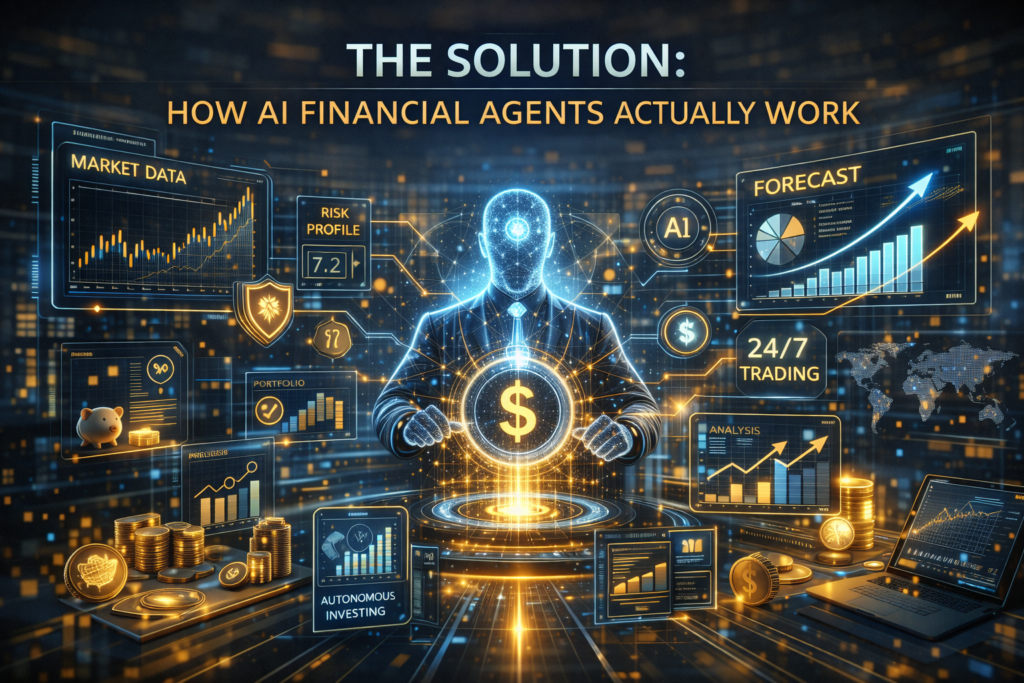
An AI Financial Agent isn’t just a basic bot; it is a hyper-intelligent data processor that never sleeps. Here is how it solves the human bottleneck:
• Alternative Data Processing: Instead of just reading stock charts, AI agents process “Alternative Data.” They scan satellite imagery of retail parking lots to predict quarterly sales. They analyze global social media sentiment in real-time. They read 10,000 corporate earnings reports in 2 seconds.
• Emotionless Execution: AI does not feel fear. It operates strictly on pre-calculated mathematical probabilities. If a stock drops, the AI doesn’t panic; it instantly calculates whether it’s a statistical buying opportunity or a structural failure, executing the optimal move instantly.
3. The 2026 Performance Audit: Human vs. AI Agent
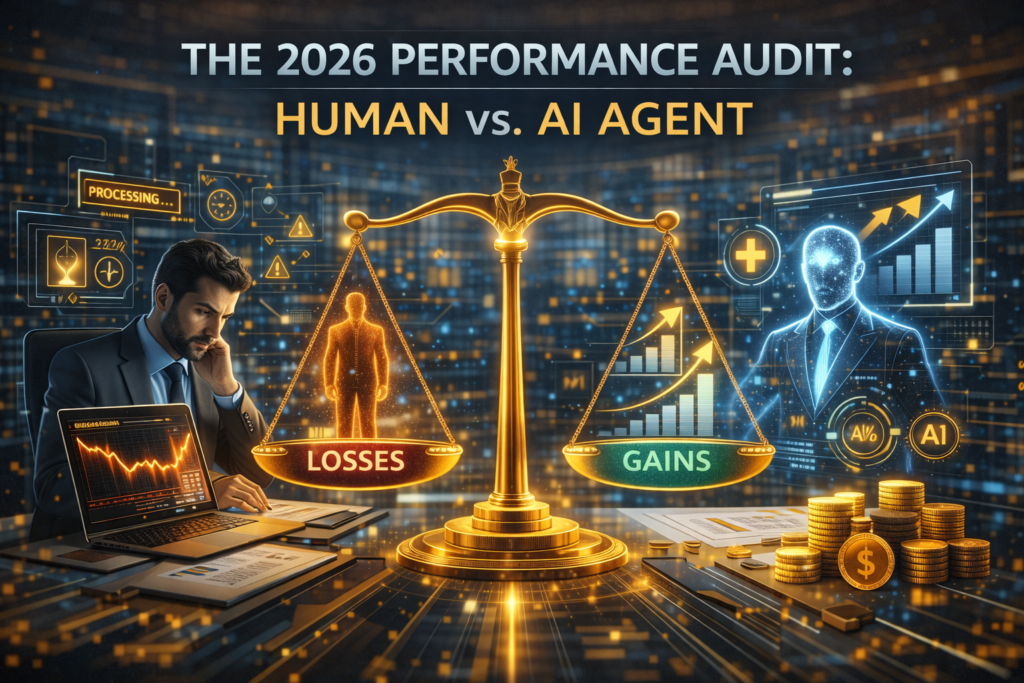
(A direct breakdown of why autonomous agents hold the ultimate advantage.)
• Data Capacity
• Human: Can track 20-50 stocks effectively.
• AI Agent: Monitors 15,000+ global assets simultaneously.
• Execution Speed
• Human: 10 seconds to 5 minutes.
• AI Agent: < 5 Milliseconds.
• Operational Cost
• Human: High management fees and hidden commissions.
• AI Agent: Flat API server costs (Nearly 100% of compound interest stays with you).
4. Addressing the Elephant in the Room: Is AI Safe with My Money?

The biggest question our readers at YourTasksAI ask is: “What if the AI goes rogue and loses everything?”
This is a valid concern, solved by Hard-Coded Risk Parameters. You do not just give an AI your money and say “go.” You set the boundaries.
• Strict Drawdown Limits: You can program the agent with a rule: “If the portfolio drops by 3% in a single day, liquidate all risky assets into cash and halt trading.” The AI cannot override this rule.
• API Security: Modern AI agents connect to your brokerage account via restricted API keys. This means the AI has permission to execute trades, but it physically cannot withdraw or transfer money out of your account. Your funds remain entirely under your control.
5. Step-by-Step: How to Transition to Autonomous Wealth Today
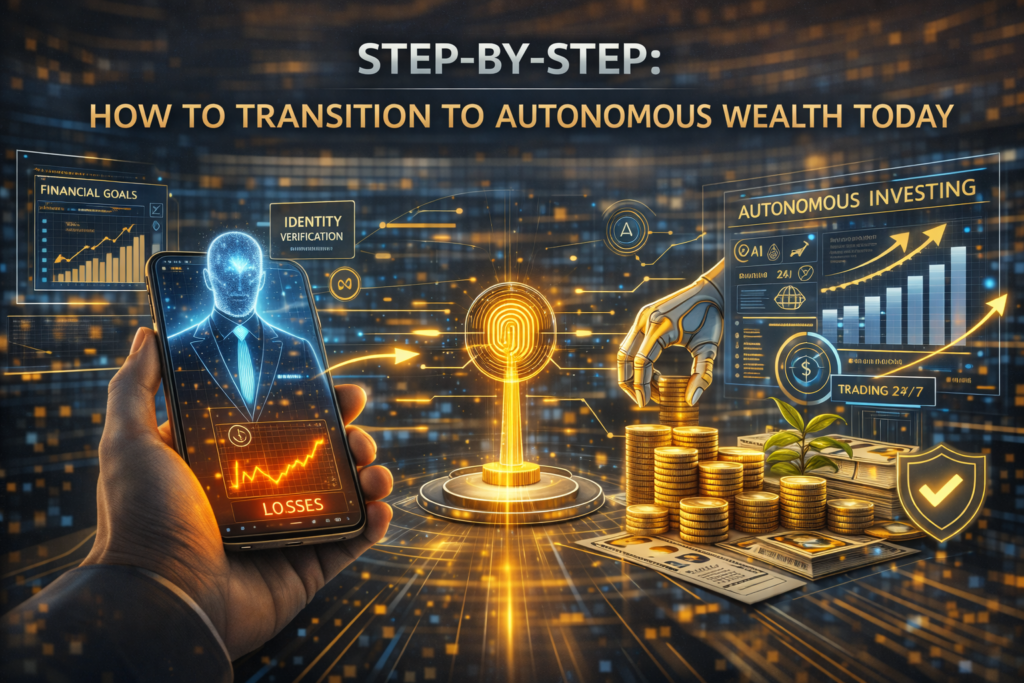
You don’t need to be a Wall Street billionaire to use this technology. Here is the exact roadmap to automate your wealth in 2026:
• Step 1: Choose an API-Friendly Brokerage. Move your funds to a modern platform (like Interactive Brokers or Alpaca) that allows algorithmic integration.
• Step 2: Define Your Strategy. Decide your risk tolerance. Do you want the AI to perform high-frequency day trading, or steady, long-term dividend investing?
• Step 3: Deploy the Agent in “Paper Trading” Mode. Run the AI with fake money for 30 days. Let it prove its profitability and risk management in real-time market conditions before giving it real capital.
• Step 4: Go Live with Human-in-the-Loop (HITL). Start with a small percentage of your portfolio. Let the AI alert you before making big moves so you can approve them, gradually giving it full autonomy as trust is built.
Conclusion: Math Over Myth

The era of paying a human to guess the stock market is over. In 2026, wealth generation is a game of data, speed, and compound logic. By integrating AI Financial Agents into your strategy, you eliminate emotion, drastically reduce fees, and secure a mathematical advantage in the global economy. The future of wealth is autonomous—make sure your portfolio is on the right side of history.