
Introduction
The next phase of digital transformation will not be driven by apps or dashboards. It will be driven by autonomous systems.
By 2030, many companies will operate with AI agents embedded into their core infrastructure — handling decision-making, optimization, reporting, and execution with minimal human supervision.
The question is no longer whether businesses will adopt AI.
The real question is how deeply AI agents will be integrated into operational systems.
What Is an Autonomous Business?

Autonomous business concept showing AI agent collaborating with corporate executives in a futuristic office
An autonomous business is an organization where critical workflows are managed by goal-driven AI agents rather than manual processes.
This does not mean humans disappear.
It means:
Humans define strategy AI agents execute and optimize
Autonomy in business refers to self-improving operational systems that adapt based on data.
From Automation to Autonomy
Traditional automation follows fixed rules.
If X happens → Do Y.
Autonomous AI agents go further:
Analyze context Evaluate multiple options Select optimal actions Learn from outcomes
This shift transforms static workflows into adaptive systems.
Core Areas That Will Become Autonomous
By 2030, the following departments are most likely to be partially autonomous:
Sales Operations
AI agents qualifying leads, adjusting outreach timing, and optimizing messaging performance.
Marketing Optimization
Budget allocation, ad performance testing, and content distribution handled dynamically by AI systems.
Customer Support
AI-driven response systems that improve through continuous feedback and conversation analysis.
Financial Monitoring
Agents tracking cash flow, forecasting risk, and detecting anomalies in real time.
Supply Chain & Logistics
Dynamic route optimization and inventory forecasting managed autonomously.
Why Companies Will Adopt Agent-Based Infrastructure
There are three primary drivers:
1. Speed
AI agents operate 24/7 without delay.
2. Scalability
Decision-making can scale without proportional increases in payroll.
3. Cost Efficiency
Reducing repetitive human tasks lowers operational costs.
Companies that resist agent integration will likely struggle to compete with faster, more adaptive competitors.
The Role of Humans in Autonomous Businesses
Contrary to popular belief, autonomous businesses do not eliminate human roles.
They shift them.
Humans move toward:
Strategic planning Oversight and governance Ethical monitoring System design
Execution-heavy roles become increasingly automated.
Risks and Governance Challenges
Autonomous systems introduce new risks:
Model bias Hallucinated reasoning Over-automation Security vulnerabilities Compliance risks
Companies must implement governance frameworks to ensure AI agents operate within defined boundaries.
Autonomy without oversight becomes instability.
Multi-Agent Ecosystems
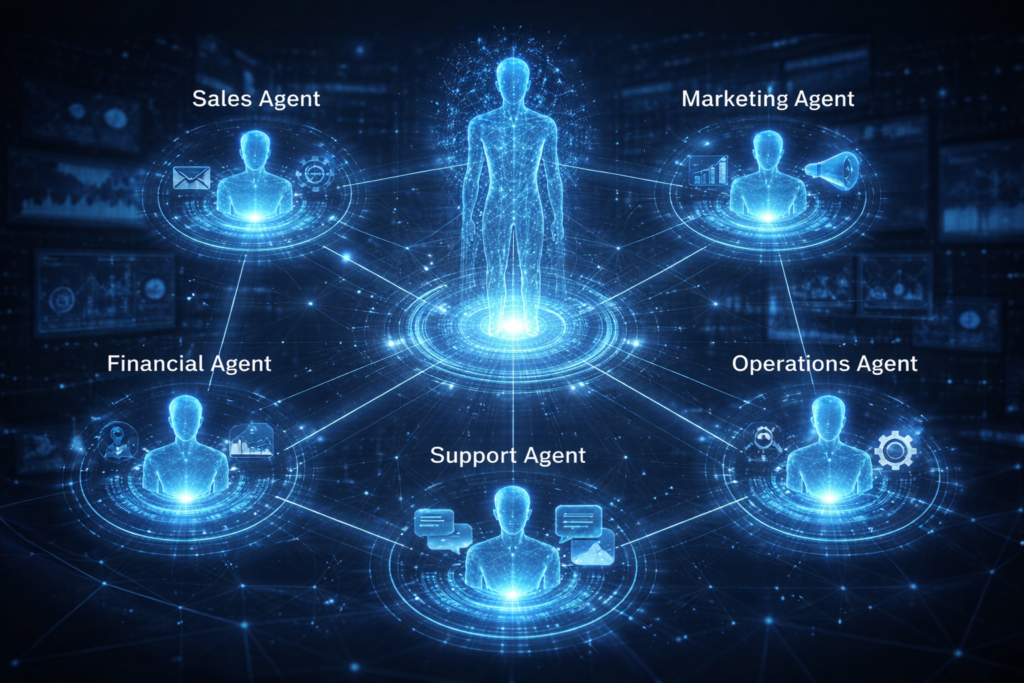
Multi-agent AI ecosystem showing specialized business agents connected within an autonomous company network
The future is not one AI system per company.
It is networks of specialized agents:
Sales Agent Marketing Agent Financial Agent Support Agent Operations Agent
These agents coordinate through shared objectives.
This architecture resembles a digital workforce operating continuously behind the scenes.
Competitive Advantage in 2030
The companies that win will not be the ones with the most employees.
They will be the ones with the most efficient autonomous systems.
Agent-based infrastructure will become a structural advantage similar to cloud computing adoption in the 2010s.
Early adopters gain exponential leverage.
Conclusion
By 2030, autonomous AI agents will not be optional tools. They will be foundational infrastructure.
Businesses that integrate agent-based systems strategically — while maintaining strong human oversight — will outperform traditional organizations in speed, adaptability, and efficiency.
The era of autonomous businesses is not approaching.
It has already begun.
FAQ
Will autonomous businesses eliminate jobs?
Not entirely. Roles will shift from execution to supervision and strategy.
Is full autonomy realistic by 2030?
Partial autonomy across key departments is highly likely.
Are small businesses able to adopt AI agents?
Yes. Adoption barriers are decreasing rapidly.
Is agent-based infrastructure expensive?
Initial implementation requires investment, but long-term cost savings are significant.