
The updated cover image for the guide: How AI Is Creating New Online Job Opportunities, now featuring the official title.
Are you worried that artificial intelligence is coming for your paycheck? You aren’t alone. However, while the headlines often focus on displacement, the reality on the ground in 2026 is far more exciting: we are witnessing the greatest expansion of the digital economy in history. The fundamental question is no longer “Will AI replace me?” but rather, how AI is creating new online job opportunities that didn’t exist even eighteen months ago. From Autonomous AI Agents to prompt engineering and AI-driven micro-SaaS businesses, the landscape of remote work has shifted from basic task execution to high-level strategic orchestration. In this comprehensive guide, you will learn about the emerging roles in the AI economy, how to pivot your existing skills, and the exact steps to capitalize on the $15 trillion AI revolution from the comfort of your home office.
The Paradigm Shift: From Task Execution to AI Orchestration
The traditional model of online work—trading hours for linear output—is fading. In its place, a new model of “Orchestration” has emerged. Today, the most successful online professionals act as conductors, managing a symphony of AI tools to produce results that previously required entire teams.
- The Rise of the “Company of One”: With autonomous AI solutions, a single freelancer can now handle content strategy, graphic design, SEO optimization, and lead generation simultaneously. This efficiency hasn’t killed jobs; it has lowered the barrier to entry for high-value services.
- Why Demand for Human Oversight is Peaking: As AI scales, the “Human-in-the-loop” (HITL) factor becomes a premium. Businesses are desperate for experts who can verify AI outputs, ensure brand alignment, and handle complex ethical nuances that algorithms still struggle to grasp.
High-Demand AI Roles Emerged in 2025-2026
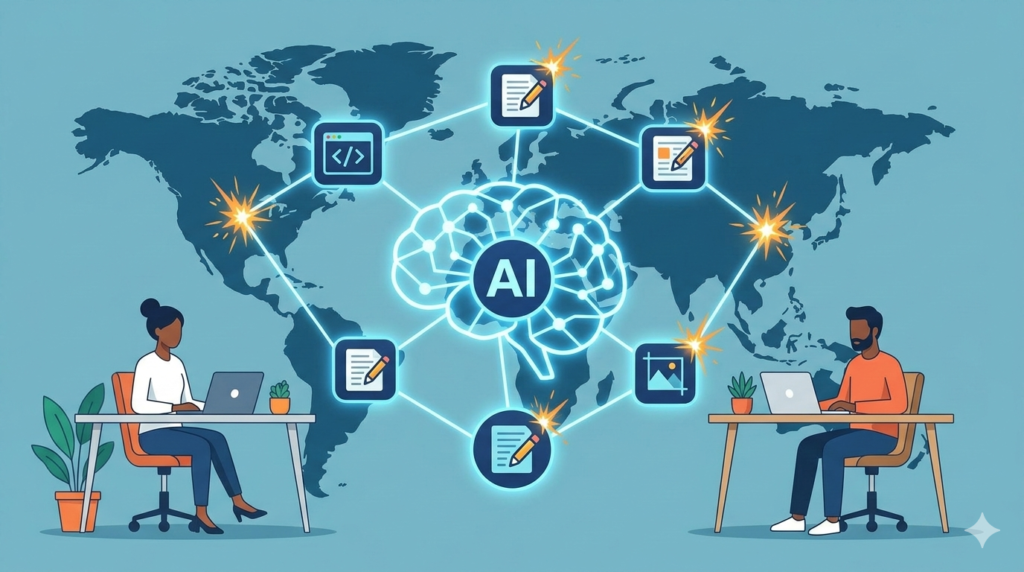
How AI is democratizing high-level job opportunities across the global digital landscape.
If you are looking for a career change, the following roles represent the “Gold Rush” of the current digital era. These positions are predominantly remote and offer significantly higher margins than traditional administrative or creative roles.
AI Agent Architect and Workflow Designer
This is perhaps the most lucrative new field. Companies are moving away from simple chatbots toward Autonomous AI Agents that can browse the web, execute code, and manage databases. The job involves designing the logic and “memory” for agents using advanced frameworks. Small businesses need these custom-built agents to handle customer support and sales 24/7.
Prompt Engineer and LLM Optimizer
While many thought prompt engineering was a fad, it has evolved into a sophisticated discipline. It’s no longer about “asking nicely”; it’s about structured output, chain-of-thought prompting, and fine-tuning models for specific industry jargon.
AI Content Strategist and Fact-Checker
Google’s 2026 algorithms prioritize “Experience, Expertise, Authoritativeness, and Trustworthiness” (E-E-A-T) more than ever. The job involves using AI to generate bulk content while providing deep human editing to ensure the content provides real-world value. This offers high-level strategic planning that AI cannot do alone.
How AI is Transforming Traditional Online Businesses
AI hasn’t just created new jobs; it has supercharged existing ones. If you are an online business owner, these transformations are key to staying competitive.
- E-commerce and AI-Driven Personalization: Drop-shipping and Shopify stores are using AI to predict trends before they happen. AI tools now analyze social media sentiment to tell you exactly which products will go viral next month.
- The New Era of Digital Marketing: SEO is no longer about keyword stuffing. It’s about Semantic Search Optimization. AI tools help marketers understand the intent behind a user’s search.
- Virtual Assistance 2.0: The modern Virtual Assistant (VA) is an AI Specialist. Instead of just managing emails, a 2026 VA sets up automated CRM workflows and uses AI to transcribe and summarize meetings.
Technical vs. Non-Technical Opportunities
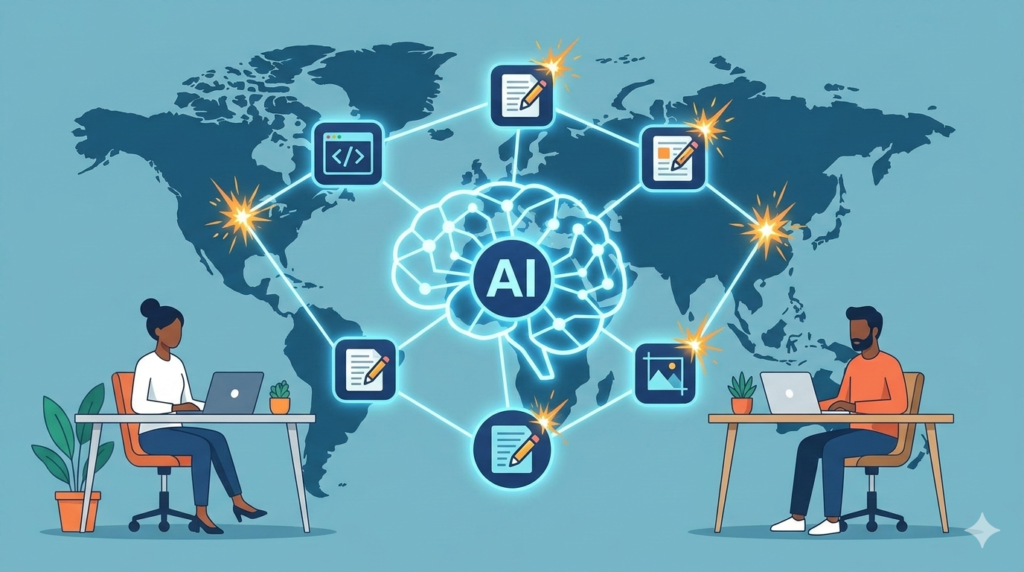
How AI is democratizing high-level job opportunities across the global digital landscape.
One of the biggest myths is that you need a computer science degree to profit from AI. This couldn’t be further from the truth.
Opportunities for Creatives
- AI Art Directors: Using Midjourney or DALL-E to create brand assets in seconds.
- Synthetic Voice Artists: Training AI models on your own voice to license it for audiobooks and commercials.
- Narrative Designers: Writing the “personalities” and scripts for AI NPCs in gaming and metaverses.
Opportunities for Educators and Coaches
The “Prompt-to-Product” pipeline allows educators to turn their knowledge into interactive AI mentors. You can now sell a “Digital Version of Your Brain” as a subscription service, providing 24/7 coaching to thousands of students simultaneously.
Strategic Advantage: Why AI-Powered Professionals Earn More
Data from 2025 suggests that professionals who integrate AI into their workflows earn, on average, 35% more than those who don’t. Here’s why:
- Speed to Market: What used to take a month now takes a day.
- Scalability: You can take on five clients instead of one.
- Data-Driven Decisions: AI provides insights that human intuition often misses, leading to better ROI for clients.
Challenges and the “Human Advantage”

The “Human Advantage”: Why empathy and strategic oversight remain irreplaceable in an AI-driven world.
While we focus on how AI is creating new online job opportunities, we must acknowledge the hurdles. The biggest challenge is the “Commoditization of Mediocrity.” If you only use AI to produce average work, you will be outcompeted by others doing the same for cheaper.
- The Empathy Gap: AI cannot build a relationship. In sales and high-ticket coaching, the “human touch” is more valuable than ever.
- Ethical AI Auditing: As companies deploy more AI, they face legal and ethical risks. This has birthed a new job market for AI Ethics Auditors.
How to Start Your AI-Driven Career Today

Virtual Assistance 2.0: Scaling businesses through data-driven AI insights and remote management.
Transitioning doesn’t require quitting your job tomorrow. It requires a “Beta-Testing” mindset.
- Identify the Bottleneck: What part of your current job is repetitive? Find an AI tool to automate it.
- Master the Stack: Learn the “Big Three” of 2026—Large Language Models, Image/Video Generators, and Automation Platforms.
- Build a Portfolio of Agents: Don’t just show a resume. Show the AI agents you have built to solve specific problems.
Conclusion: The Future is Collaborative
The narrative of “Man vs. Machine” is being replaced by “Man + Machine.” As we’ve explored, how AI is creating new online job opportunities is through the democratization of high-level tools. You no longer need a million-dollar budget to compete with global agencies; you just need the right prompts and a strategic mindset. The digital economy of 2026 rewards the curious. By embracing AI today, you aren’t just protecting your career; you are positioning yourself at the forefront of the most significant economic shift of our century.
Frequently Asked Questions About AI Job Opportunities
Q1: Can I get an AI job without any coding skills?
Absolutely. Most of the new job opportunities focus on “No-Code” platforms and natural language interfaces. Roles like AI Content Strategist, Prompt Engineer, and AI Business Consultant require logical thinking and domain expertise rather than the ability to write Python or C++.
Q2: Is Prompt Engineering a long-term career?
It is evolving. While simple prompting is becoming easier, “Advanced Prompt Engineering”—which involves multi-step reasoning and integrating AI into complex workflows—remains a highly specialized and well-paid skill.
Q3: How long does it take to learn these new AI tools?
The learning curve is short. You can gain functional proficiency in major AI tools within 2-4 weeks of dedicated practice. However, mastering the strategy of how to use them to solve business problems is an ongoing process.
Q4: Which industries are seeing the most AI job growth?
Marketing, Software Development, Customer Service, and Legal Services are leading the charge. However, we are also seeing growth in “Niche AI Consulting” for industries like real estate or healthcare.
Q5: Will AI lower the salaries of online workers?
For low-skill, repetitive tasks, yes. However, for those who use AI to deliver higher value, faster results, and deeper insights, salaries are actually increasing.
Q6: How do I prove my AI skills to a potential employer?
Stop telling and start showing. Create a portfolio that includes “Before and After” case studies of processes you’ve automated. Build a custom GPT or AI Agent that solves a specific problem.
Q7: Are these AI jobs stable?
No job is 100% stable, but AI-related roles are currently the most “future-proof.” By being the person who understands the technology, you become the person the company relies on.
Q8: What are the best platforms to find AI-related remote work?
Beyond LinkedIn and Upwork, look at specialized platforms like Remote Rocketship, AI Jobs Board, and PromptBase.
Q9: Is it too late to start learning about AI?
We are still in the “Early Adopter” phase. While the first wave of generative AI has passed, the second wave—Autonomous Agents—is just beginning. Starting today puts you ahead of 90% of the workforce.
Q10: How much can a freelance AI Consultant earn?
In 2026, entry-level AI consultants often start at $50-$100 per hour. Specialized architects who design entire autonomous workflows can command rates upwards of $300-$500 per hour.
Q11: Do I need expensive hardware to work in AI?
No. Most AI tools are cloud-based. A standard laptop with a stable internet connection is all you need to access the world’s most powerful supercomputers.
Q12: How do I stay updated on AI trends without getting overwhelmed?
Follow a few key resources: specialized AI newsletters, industry subreddits, and official blogs from major labs like Google DeepMind. Focus on tools that directly impact your niche.