
Introduction
Artificial Intelligence is rapidly evolving from simple prompt-based tools into fully autonomous systems capable of planning, reasoning, and executing complex tasks independently. In 2026 and beyond, the real competitive advantage lies not in occasionally using AI tools, but in deploying autonomous AI agents that operate continuously with minimal human supervision.
Autonomous AI agents represent a structural shift in how software systems function. They are not reactive assistants waiting for instructions. They are proactive systems designed to pursue defined objectives, make decisions, execute actions, and optimize performance over time.
What Are Autonomous AI Agents?
An autonomous AI agent is a goal-driven software system that can analyze information, make decisions, execute actions, and refine its strategy without continuous human input.
Unlike traditional AI assistants that respond to prompts, autonomous agents:
Break down complex objectives into smaller tasks Select appropriate tools and resources Execute multi-step workflows Evaluate results Improve future performance
In short:
An assistant responds.
An agent acts.
Core Components
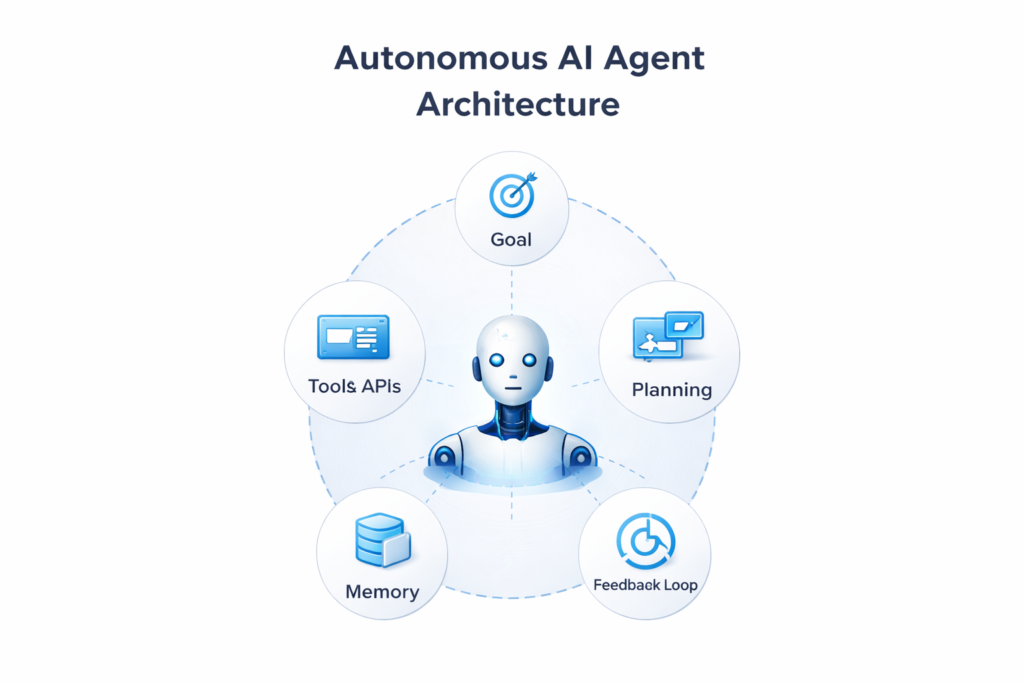
Goal Definition Layer
Every autonomous AI agent begins with a clearly defined objective. Without a measurable goal, autonomy becomes uncontrolled automation.
Goals may include increasing revenue, reducing operational costs, improving system efficiency, detecting fraud, or optimizing customer engagement. A precise goal ensures that all actions taken by the agent align with strategic outcomes.
Planning and Reasoning Engine
The planning and reasoning engine is the decision-making core of an autonomous AI agent. It evaluates available data, prioritizes tasks, and determines the optimal sequence of actions.
For example, in a business environment, an agent may decide whether to adjust pricing, trigger a marketing campaign, or reallocate resources based on real-time performance data.
This reasoning layer transforms raw intelligence into structured action.
Memory System
Memory enables AI agents to retain contextual and historical information.
Short-term memory manages active tasks and session-specific data.
Long-term memory stores performance metrics, behavioral patterns, and historical outcomes.
This layered memory structure allows agents to learn from previous actions and continuously improve decision-making accuracy.
Tool and API Integration
Autonomous AI agents must interact with external systems to execute real-world actions.
These integrations may include:
CRM platforms Databases Payment gateways Analytics tools Cloud infrastructure Marketing automation systems
Without tool connectivity, an AI system can analyze but cannot act. Integration transforms intelligence into operational capability.
Feedback and Iteration Loop
Continuous feedback is what makes autonomous systems adaptive.
After each action, the agent evaluates results using predefined performance metrics. If outcomes fall short of expectations, the system refines its strategy and attempts alternative approaches.
This iterative loop enables optimization over time and reduces reliance on manual intervention.
How Autonomous AI Agents Work
A typical autonomous workflow follows these steps:
Receive a clearly defined objective. Analyze available data. Decompose the goal into actionable tasks. Select appropriate tools and execution paths. Execute actions. Evaluate results. Adjust strategy if necessary.
This cycle repeats continuously, creating self-directed automation.
Real-World Use Cases
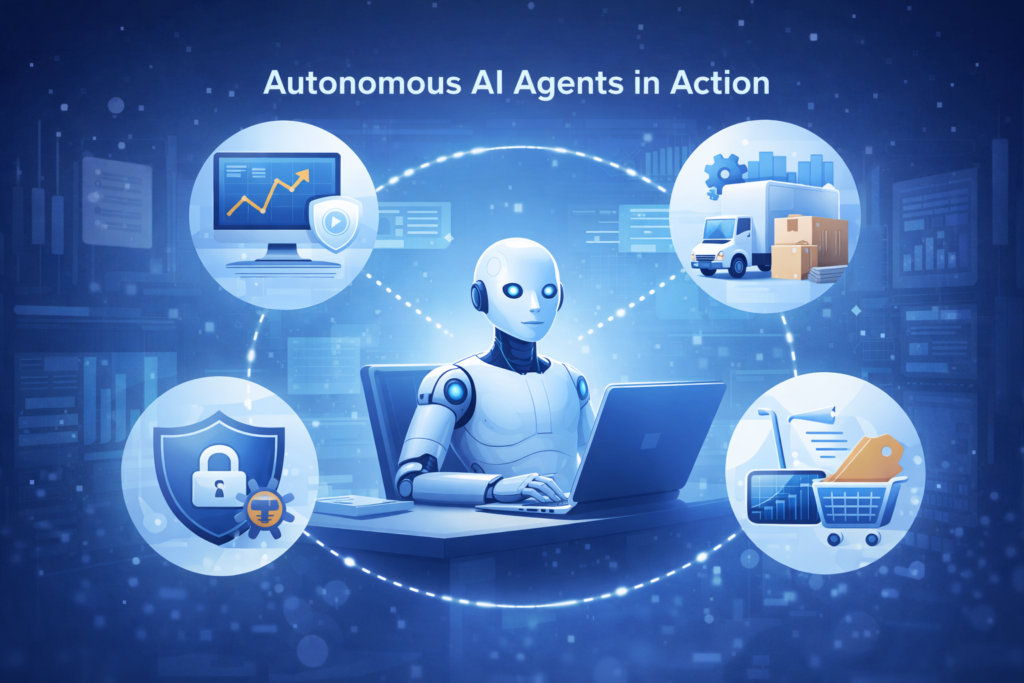
Autonomous AI agents are already transforming multiple industries.
In finance, they monitor transactions and detect anomalies.
In cybersecurity, they identify threats and initiate defensive actions.
In e-commerce, they optimize pricing and personalize customer experiences.
In enterprise operations, they automate repetitive workflows and internal processes.
These systems increase efficiency while reducing manual workload.
Advantages
Autonomous AI agents provide:
24/7 operation Scalable decision-making Rapid execution Data-driven optimization Reduced operational costs Continuous learning capability
Organizations that deploy agent-based systems gain structural speed advantages over competitors relying solely on human-driven processes.
Limitations
Despite their potential, autonomous systems require proper governance.
Common challenges include:
Hallucination or reasoning errors Over-automation of sensitive processes Security vulnerabilities in API integrations Compliance risks in regulated industries
Human oversight remains essential, particularly in strategic and high-risk environments.
Future Outlook
The future of autonomous AI lies in multi-agent ecosystems. Separate agents may handle pricing, logistics, marketing, cybersecurity, and analytics simultaneously, coordinating through shared objectives.
We are moving toward agentic infrastructures where businesses operate through semi-autonomous digital operators supported by human strategic supervision.
Organizations that adopt this model early will gain sustainable competitive advantages in speed, scalability, and adaptability.
Conclusion
Autonomous AI agents represent a fundamental evolution in intelligent systems. By combining reasoning, memory, execution capability, and feedback mechanisms, they enable software to operate independently toward defined goals.
The shift from reactive tools to proactive autonomous agents will define the next phase of digital transformation.
Frequently Asked Questions (FAQ)
What is the difference between an AI assistant and an AI agent?
An AI assistant responds to prompts, while an AI agent acts independently toward a defined objective.
Are autonomous AI agents safe to deploy?
They can be safe when implemented with monitoring systems, access controls, and governance frameworks.
Do autonomous AI agents require coding knowledge?
Advanced implementations require technical expertise, though no-code platforms are emerging.
Can AI agents replace employees?
They automate repetitive and data-driven tasks but still require human oversight for strategic direction.
What industries benefit most from autonomous AI agents?
Finance, cybersecurity, e-commerce, logistics, SaaS, and enterprise operations currently see the strongest impact.