
Figure 1: Mastery of prompt engineering requires a strategic blend of human logic and AI efficiency.
Meta Description: Master the art of AI communication with this guide to prompt engineering mastery. Learn advanced frameworks, SEO tips, and workflows to boost your productivity.
Do you know that 70% of professionals fail to get accurate results from AI because of poor communication? Artificial intelligence is like a high-speed engine that needs a skilled driver. Without the right commands, even the most powerful models produce generic or incorrect data. This comprehensive guide to prompt engineering mastery will teach you how to talk to machines like a pro.
You will learn the core frameworks that define high-quality AI outputs. We will explore advanced techniques like Chain-of-Thought and Few-Shot prompting. You will also discover how to integrate these skills into your daily business workflows. This knowledge will turn you into an AI orchestrator rather than just a casual user. Let’s begin your journey toward technical excellence and efficiency.
Understanding the Core Logic of Prompt Engineering
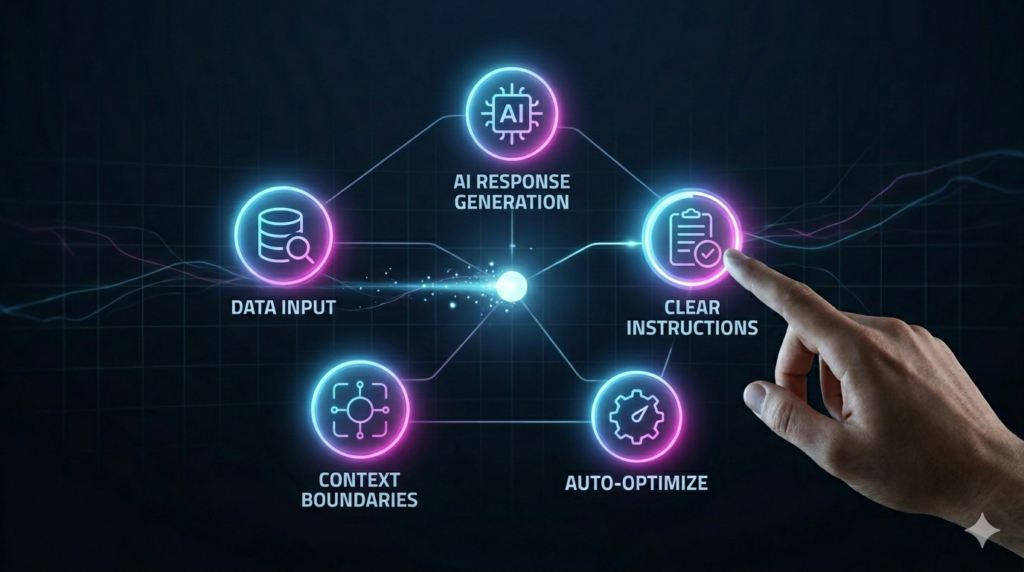
Figure 2: Visualizing the input and feedback loops required for effective, automated prompt engineering.
Prompt engineering mastery starts with understanding how Large Language Models (LLMs) process your words. These models do not “think” like humans but predict the next likely token in a sequence. Your prompt acts as the steering wheel for this complex mathematical process. Clear instructions reduce the chance of errors and hallucinations.
You must provide a structured environment for the model to work within. Think of your prompt as a job description for a highly capable intern. If you are vague, the intern will make mistakes. If you are precise, you get perfect results every time.
The Role of Tokens and Context Windows
Every word or character you send is broken down into small units called tokens. Mastery involves managing these tokens effectively to stay within the model’s memory limits. Providing too much irrelevant data can confuse the AI. Focus on high-value information to keep the output sharp and relevant.
Real-World Example: Coding Assistance
Imagine you are a developer struggling with a complex Python bug. Instead of saying “fix this code,” you provide the specific error log and the desired outcome. You tell the AI to act as a Senior Backend Engineer. The AI then provides a modular fix instead of a messy patch.
The Six Building Blocks of a Perfect Prompt

Figure 3: Structuring AI prompts using proven frameworks like Role-Context-Task-Constraints.
Mastering the structure of a prompt is the fastest way to improve your results. A professional prompt usually contains six specific elements that guide the AI’s logic. You do not always need all six, but using them consistently ensures high quality. These blocks create a roadmap for the AI to follow from start to finish.
The first block is the Role, which gives the AI a persona. The second is Context, providing background information on the task. Task defines the specific action you want the AI to perform. Constraints set the rules, such as word counts or forbidden topics. Format dictates how the data should look, like a table or JSON. Finally, Examples show the AI what a “good” answer looks like.
Defining Your AI Persona
Assigning a role narrows the AI’s vast knowledge into a specific field. Tell the AI to be a “Harvard-educated lawyer” or a “creative copywriter.” This changes the tone, vocabulary, and depth of the response immediately. It is the most powerful way to shift the model’s perspective.
Using Few-Shot Prompting for Consistency
Few-Shot prompting involves giving the AI a few examples of input and output pairs. This is essential for maintaining a specific brand voice or complex formatting. If you want the AI to write in your unique style, show it three previous blog posts. The AI will mimic the structure and flow with incredible accuracy.
Advanced Cognitive Strategies for AI Mastery
Once you know the basics, you must learn advanced cognitive strategies to push the AI further. These techniques force the model to engage in deeper “reasoning” before it answers you. This is crucial for solving math problems, logical puzzles, or strategic business challenges. Prompt engineering mastery requires these higher-level thinking frameworks.
One of the most effective methods is Chain-of-Thought (CoT) prompting. You simply ask the AI to “think step-by-step” before providing a final conclusion. This reduces logical errors by making the AI show its work. It allows the model to catch its own mistakes during the generation process.
The Power of Self-Criticism Prompts
You can ask the AI to review its own work to find flaws. Tell the AI to “Identify three weaknesses in the previous response and rewrite it.” This creates a feedback loop that significantly improves the final quality. It ensures that the output meets high professional standards before you see it.
Scenario: Strategic Business Planning
Suppose you are planning a market entry for a new tech product. You use a CoT prompt to analyze competitors, pricing, and distribution. You then ask the AI to play “devil’s advocate” and find risks in that plan. This two-step process gives you a balanced and deep strategy.
Technical Nuances and Structural Delimiters
Structure is just as important as the words you choose in your prompt. Using delimiters like triple quotes or XML tags helps the AI distinguish between instructions and data. This prevents “instruction injection” where the AI confuses your content with your commands. Mastery of these technical details makes your prompts more robust and reliable.
Modern models respond exceptionally well to clean, organized inputs. You should use headers, bullet points, and clear sections within your prompt. This helps the AI follow the hierarchy of your instructions. It also makes your own prompts easier to read and reuse in the future.
Utilizing XML Tags for Clarity
XML-style tags like <context> or <instruction> are highly effective for modern LLMs. They create a clear “container” for specific parts of your prompt. This is especially useful when you are feeding the AI long documents to analyze. It ensures the AI knows exactly which part of the text it should focus on.
Managing Temperature and Top-P
Temperature is a setting that controls how “creative” or “random” the AI’s response is. A low temperature is best for facts, coding, and data extraction. A high temperature is perfect for brainstorming and creative writing. Understanding how to adjust these settings gives you total control over the AI’s output.
Integrating AI Into Professional Workflows

Figure 4: Repurposing master prompts into specific professional workflow automations.
Mastery is not just about writing a good prompt; it is about building a system. You should create a “Prompt Library” of your most effective commands. This allows you to repeat successful results across different projects and teams. It turns a manual task into a scalable business process.
Use AI to automate the boring parts of your job so you can focus on creativity. Ask the AI to summarize long meetings or draft routine emails. Use it to generate initial outlines for reports or social media campaigns. This leverage allows you to work faster than ever before.
Scenario: Automated Content Research
A research analyst uses a set of master prompts to scan hundreds of articles. The prompts extract key stats and expert quotes into a neat Markdown table. What used to take eight hours now takes fifteen minutes. This is the true power of prompt engineering mastery in action.
Building Agentic Workflows
The future of AI is “Agents” that can perform multiple steps without your help. You can prompt an agent to research a topic, write a post, and then schedule it. This requires a very high level of prompting skill to ensure the agent stays on track. Start practicing multi-step instructions today to prepare for this future.
SEO Optimization with Prompt Engineering
You can use AI to dominate search engine results if you understand SEO logic. Mastery involves prompting the AI to identify LSI keywords and search intent. Ask the AI to analyze the top-ranking results for your keyword. Then, tell it to create a content outline that covers all those points and more.
SEO content must be both helpful for humans and readable for bots. Use the AI to generate catchy meta titles and high-conversion meta descriptions. Tell it to structure your blog posts with proper H1, H2, and H3 hierarchies. This ensures that your content is perfectly optimized for modern search algorithms.
Finding Semantic Content Gaps
Ask the AI: “What important questions are my competitors missing on this topic?” Use the answer to create unique sections that add more value than anyone else. This “Gap Analysis” is a key strategy for ranking on the first page of Google. It ensures your content is original and authoritative.
Example: E-commerce Product Descriptions
A store owner uses AI to rewrite 500 product descriptions for better SEO. They prompt the AI to focus on emotional benefits while including high-volume keywords. The new descriptions increase organic traffic by 40% in just two months. This shows how prompting scales business growth.
Psychology and Persuasion in AI Communication

Figure 5: The future of professional output involves humans directing agentic AI workflows.
Language is a psychological tool, and AI is highly sensitive to the “weight” of words. Using strong verbs and clear directives improves the model’s focus. You can even use emotional cues like “This is critical for my career” to increase performance. Mastery involves understanding these subtle linguistic triggers.
Always frame your instructions positively for the best results. Tell the AI “Do X and Y” instead of “Don’t do Z.” Positive commands are easier for the model’s neural network to process. This leads to more direct and useful outputs that align with your true intent.
Tone and Voice Calibration
To master tone, you must give the AI specific adjectives to follow. Instead of “professional,” try “authoritative but empathetic.” This precision helps the AI match your brand personality exactly. It prevents the output from sounding like a generic robot.
Scenario: High-Stakes Email Negotiation
You need to draft a delicate email to a client about a budget increase. You prompt the AI to act as a world-class negotiator. You give it the background of the relationship and your specific goals. The AI produces a draft that is firm but preserves the partnership.
Conclusion: Your Roadmap to AI Excellence
Mastering prompt engineering is the most important skill for the modern workforce. You have learned how to use roles, context, and constraints to get perfect results. You explored advanced strategies like Chain-of-Thought and technical delimiters. Prompt engineering mastery is a journey of constant learning and experimentation.
As AI models get better, your ability to guide them will remain your greatest edge. Treat every interaction as a chance to refine your technique. Build your library, automate your tasks, and stay curious about new features. The world of AI is moving fast, and you are now ready to lead.
The next step is to take these frameworks and apply them to your daily tasks. Start small, track your results, and iterate on your prompts. You will soon see a massive jump in your productivity and output quality. For more specific help, check out our frequently asked questions below to solve common problems.
Frequently Asked Questions About Prompt Engineering Mastery
### Q1: What is the most common mistake beginners make in prompting?
The most common mistake is being too vague or brief in your instructions. Beginners often treat AI like a human search engine instead of a capable worker. They ask “write a blog post” and get a generic, useless result. To achieve prompt engineering mastery, you must provide a role, context, and clear constraints. Detailed instructions are the secret to getting professional-grade work from any AI model.
### Q2: How can I stop the AI from making up facts or hallucinating?
You can reduce hallucinations by using “grounding” techniques in your prompts. Tell the AI: “Only use the provided text to answer.” Ask it to provide direct quotes or citations for every claim it makes. Another tip is to ask the AI to say “I don’t know” if the answer is not available. These constraints force the AI to look at the data instead of guessing.
### Q3: Why should I ask the AI to “think step-by-step”?
Asking the AI to “think step-by-step” activates a process called Chain-of-Thought reasoning. It forces the model to break a complex problem into smaller, logical parts. This significantly improves accuracy in math, logic, and planning tasks. It allows the AI to “see” the steps it is taking before it gives a final answer. This is a foundational technique for prompt engineering mastery.
### Q4: Is prompt engineering still useful as AI gets smarter?
Yes, prompt engineering becomes even more important as AI models become more capable. Smarter models can handle more complex instructions and nuanced roles. Your ability to articulate a clear vision and set strict boundaries will always be needed. Think of it like a conductor leading a high-end orchestra. The better the musicians, the more important the conductor’s guidance becomes.
### Q5: Can I use the same prompt for GPT-4, Claude, and Gemini?
While many prompts work across different models, each one has its own “personality.” Some models follow XML tags better, while others are better at creative prose. Mastery involves testing your prompts on different platforms and adjusting them slightly. You might need to change a few words or the order of instructions to get the best result. Always be ready to adapt to the specific model you are using.
### Q6: How do I maintain a consistent brand voice with AI?
The best way is to use Few-Shot prompting with clear examples of your voice. Provide three to five snippets of your best writing to the AI. Tell it: “Analyze the tone, rhythm, and vocabulary of these examples.” Then, ask it to write the new content using that exact style. This ensures that every piece of content sounds like it came from you.
### Q7: What are delimiters and why do they matter?
Delimiters are characters like """, ---, or tags like <text> that separate sections of your prompt. They tell the AI exactly where your instructions end and your data begins. This prevents the AI from getting confused if your data contains its own instructions. Using delimiters is a sign of prompt engineering mastery because it makes your commands much more reliable.
### Q8: How long should my prompts be?
Your prompts should be as long as necessary to provide all the needed context, but no longer. Focus on clarity and density rather than just word count. A long prompt filled with “fluff” can actually confuse the AI. Give the AI exactly what it needs to succeed and nothing more. Efficiency is a key part of mastery.
### Q9: Can AI help me with complex coding tasks?
Absolutely, AI is one of the best tools for coding if you prompt it correctly. Provide the AI with the specific programming language, the desired logic, and any error messages. Use a role like “Expert Python Developer” to get cleaner and more efficient code. You can also ask the AI to write unit tests to verify that the code actually works as intended.
### Q10: How can I improve my prompts for creative writing?
For creative writing, give the AI a specific atmosphere and sensory details to focus on. Instead of saying “write a scary story,” describe the specific “vibe” you want. Use adjectives like “noir,” “whimsical,” or “claustrophobic.” Ask the AI to use metaphors and show, not tell. This level of detail turns a generic story into a unique piece of art.
https://bestcrmsoftware.tech/best-crm-for-small-tech-startups-2026/
https://bestcrmsoftware.tech/best-crm-for-small-service-business-2026/