
Introduction
For decades, starting a business required capital.
You needed:
Office space Employees Marketing budget Operational staff Software infrastructure
Scaling meant increasing expenses before increasing profit.
But artificial intelligence is reshaping that equation.
Today, it is possible to build a lean, AI-driven business with minimal upfront cost — and scale it without proportionally increasing operational complexity.
This does not mean “easy money.”
It means structural leverage.
The difference between traditional businesses and lean AI-driven businesses is not effort.
It is architecture.
The Myth of “Zero Capital”
Let’s clarify something immediately.
$0 does not mean literally no cost.
It means no heavy upfront investment.
In the AI era, capital shifts from physical assets to digital leverage:
Cloud tools AI subscriptions Automation platforms Knowledge
Instead of hiring a team, you design systems.
Instead of renting space, you operate digitally.
Instead of building departments, you build workflows.
The barrier to entry is lower — but strategic thinking becomes more important.
What Is a Lean AI-Driven Business?
A lean AI-driven business is built on three principles:
Minimal fixed costs Maximum automation Scalable digital infrastructure
It avoids unnecessary complexity.
It does not hire early.
It does not build bureaucracy.
It does not expand overhead prematurely.
Instead, it focuses on:
Offer clarity Process efficiency System repeatability
AI becomes the operational amplifier.
Step 1: Define a High-Leverage Offer
Before tools, before automation, before AI — you need leverage.
A scalable business begins with an offer that:
Solves a specific problem Has measurable value Can be delivered digitally Can be systemized
Examples:
AI-powered marketing consulting Automation setup services Niche AI content production AI integration for small businesses Micro-SaaS solutions
If your offer depends entirely on manual time, it will not scale — even with AI.
Step 2: Map the Workflow Before Automating
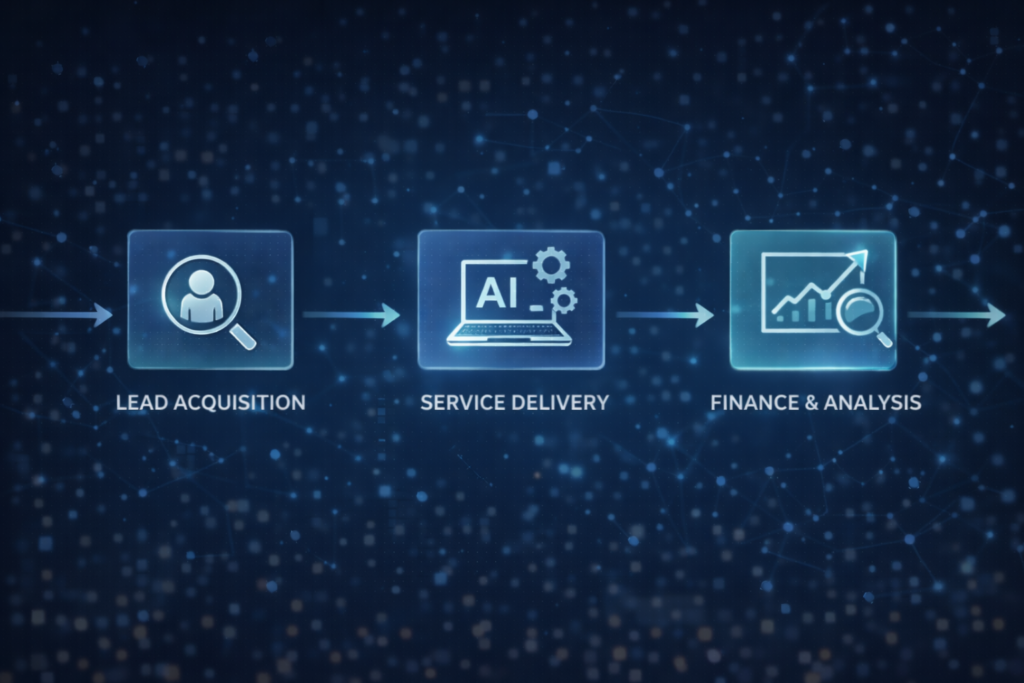
Many founders make a mistake:
They automate chaos.
Instead, define your process:
Lead acquisition Qualification Sales communication Delivery Follow-up Retention
Write it down.
Only then integrate AI.
AI should optimize a system — not replace thinking.
Step 3: Build Your AI Infrastructure
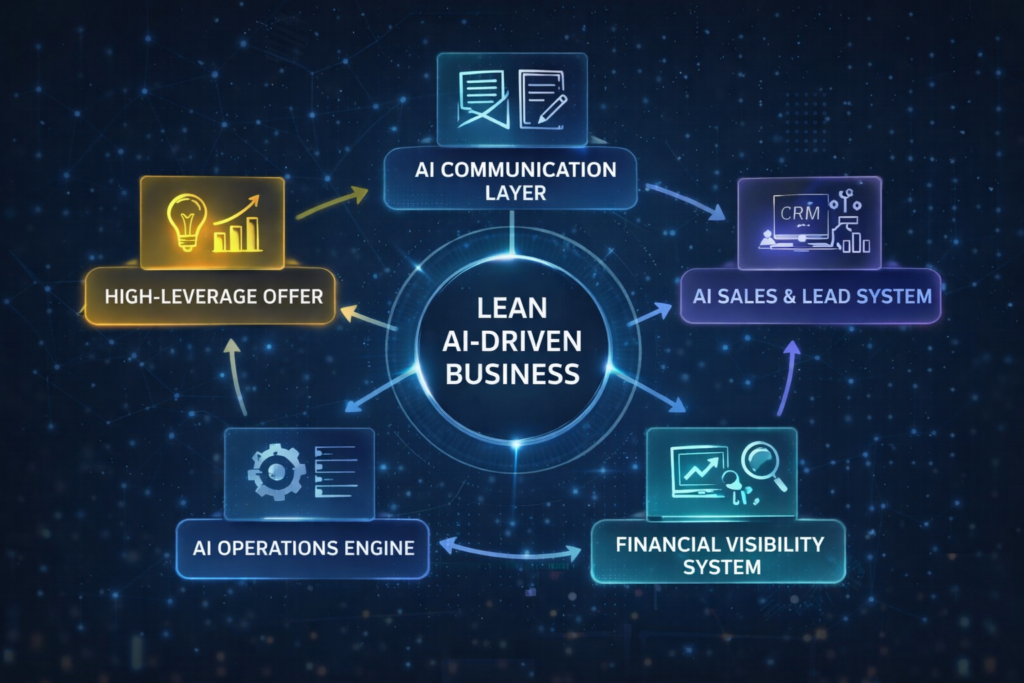
A lean AI-driven business typically includes:
1. AI Communication Layer
Handles:
Email drafting Proposal creation Content structuring Client documentation
You supervise and refine.
2. AI Sales & Lead System
Supports:
Lead scoring Personalization Outreach scripting CRM tracking
AI increases volume without increasing cognitive load.
3. AI Operations Engine
Automates:
Task triggers Reporting KPI monitoring Deadline tracking
This reduces founder burnout.
4. Financial Visibility System
AI-assisted forecasting tools can:
Track cash flow Identify expense patterns Suggest pricing optimization
Lean does not mean blind.
You must monitor performance continuously.
The Power of Asymmetric Scaling
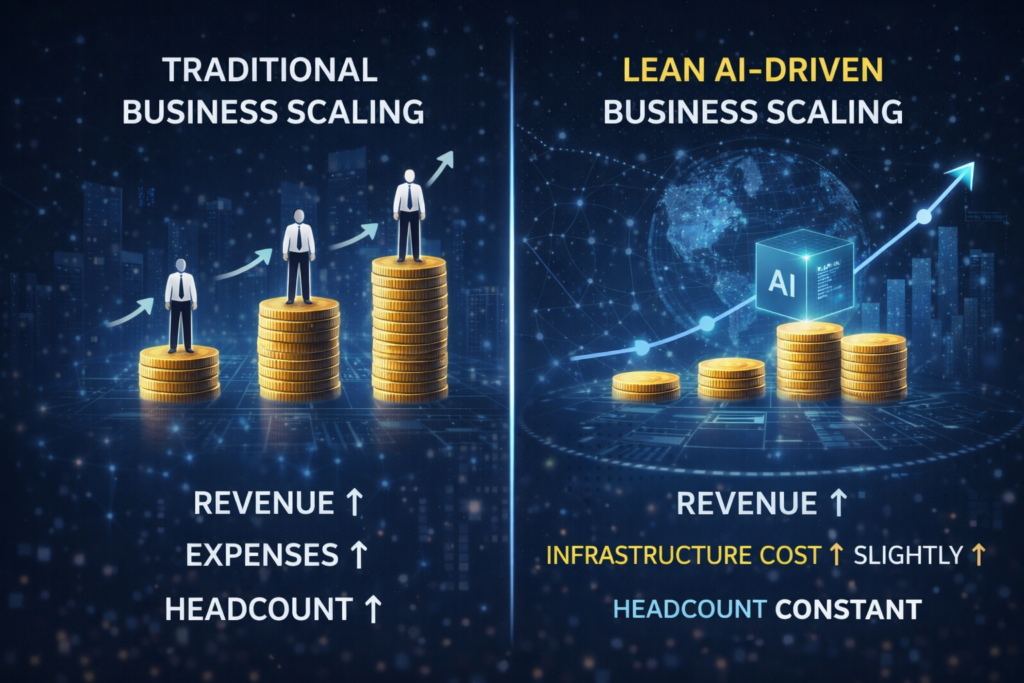
Traditional scaling requires:
Revenue ↑
Expenses ↑
Headcount ↑
AI-driven scaling looks different:
Revenue ↑
Infrastructure cost slightly ↑
Headcount constant
This creates asymmetric growth.
The margin improves as efficiency improves.
However, this only works if:
Processes are repeatable Delivery is structured Quality control is maintained
Without structure, scaling collapses.
Where the Real Leverage Happens
The biggest advantage of a lean AI business is speed.
You can:
Test new offers quickly Adjust pricing dynamically Launch content at scale Experiment with positioning Enter niche markets fast
Large companies cannot pivot at this speed.
Lean AI structures thrive in volatile markets.
Risk Factors You Must Respect
This model is powerful — but fragile if mismanaged.
1. Over-Automation
Blindly trusting AI output damages brand trust.
Human oversight is mandatory.
2. Tool Dependency
Too many disconnected tools create complexity.
Keep your stack simple.
3. Weak Positioning
AI cannot fix a weak offer.
Clarity beats automation.
4. Burnout Through Micromanagement
Trying to manually override everything defeats leverage.
Design systems. Don’t babysit them.
The Transition from $0 to Revenue
Most lean AI businesses follow this path:
Phase 1 – Skill Monetization
Use AI to enhance personal service.
Phase 2 – Process Structuring
Turn service into systemized workflow.
Phase 3 – Semi-Automation
AI handles repetitive operations.
Phase 4 – Scalable Infrastructure
Focus shifts to growth and optimization.
The mistake many founders make is trying to jump to Phase 4 immediately.
Build in layers.
Industries Where This Model Works Best
This model performs well in:
Digital consulting Marketing services Online education SaaS AI integration services Automation agencies Content-driven businesses
It performs poorly in capital-intensive sectors like:
Manufacturing Heavy logistics Highly regulated industries
Know your field.
The Psychological Shift Required
The hardest part of building a lean AI-driven business is mental.
You must stop thinking:
“How can I do more?”
And start thinking:
“How can my system handle more?”
You are not the worker.
You are the architect.
This shift defines scalability.
The Long-Term Advantage
By 2030, the market will divide into:
Heavy overhead companies Lean AI-structured operators
The latter will:
Adapt faster Spend less Experiment more Compete globally Operate 24/7
They will not always be larger.
But they will be more efficient.
Efficiency compounds.
Is $0 Truly Enough?
In practice, you will invest in:
AI subscriptions Hosting Basic software
But compared to traditional startup costs, this is minimal.
The real investment is strategic clarity.
Money is no longer the primary barrier.
Design is.
Conclusion
The journey from $0 to scalable is no longer about raising capital.
It is about designing leverage.
A lean AI-driven business:
Minimizes fixed cost Maximizes automation Maintains human oversight Focuses on systems Scales intelligently
AI does not guarantee success.
But when combined with structure, discipline, and strategic thinking, it becomes the most powerful operational multiplier available to modern entrepreneurs.
The future belongs to those who build smart — not big.
Frequently Asked Questions (FAQ)
Can I really start with zero money?
You can start with minimal cost, but you will need access to digital tools and internet infrastructure.
Is this model sustainable long-term?
Yes, if governance, quality control, and brand positioning remain strong.
What is the biggest mistake beginners make?
Automating before defining a clear offer and workflow.
Do I need technical coding skills?
Not necessarily. Many AI tools and automation platforms are no-code.
How long does it take to become scalable?
It depends on the clarity of your offer and system design. Most founders require structured experimentation before reaching stable scalability.