
Introduction
For decades, businesses have relied on human coordination, layered management structures, and fragmented software tools to operate. Even in the age of digital transformation, most organizations still function as collections of departments connected by meetings, emails, and manual workflows.
However, a new operational model is emerging — one powered by autonomous AI agents.
By 2030, the companies that dominate their industries will not simply use AI tools. They will be structured around AI-driven operational layers. Sales, marketing, finance, logistics, customer support, and even strategic planning will increasingly be handled by specialized AI agents operating within coordinated ecosystems.
This shift is not about automation replacing humans. It is about redesigning how businesses function at a structural level.
The future of autonomous businesses is not theoretical. It is architectural.
From Automation to Autonomy
Most organizations today are in the automation phase.
They use:
CRM automation Email marketing sequences Chatbots Reporting dashboards Workflow tools
But these systems are reactive. They follow pre-defined rules.
Autonomous AI agents operate differently.
An autonomous system:
Defines micro-goals based on macro objectives Interprets contextual data Makes conditional decisions Executes actions across tools Evaluates outcomes Adjusts strategies independently
The difference between automation and autonomy is decision-making authority.
Automation executes.
Autonomy evaluates and adapts.
By 2030, competitive companies will move beyond simple automation into structured agent-based operations.
The Rise of the Digital Workforce
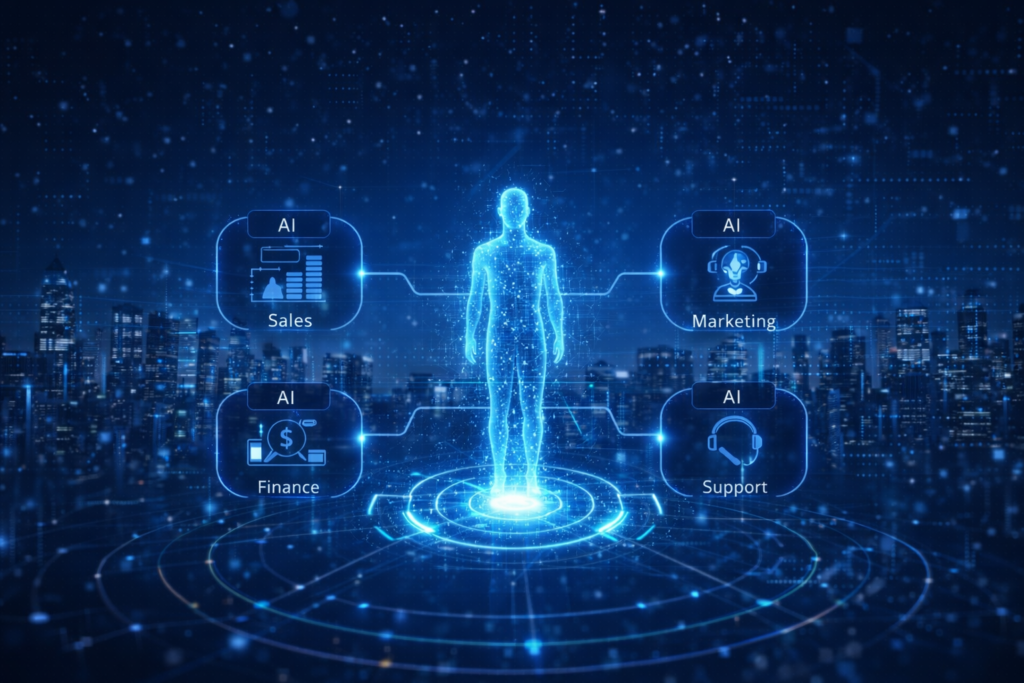
Traditional companies are structured around departments:
Sales Marketing Finance Operations Support HR
Each department operates with its own tools, KPIs, and workflows. Coordination often happens through management oversight.
In autonomous businesses, these departments evolve into specialized AI agents.
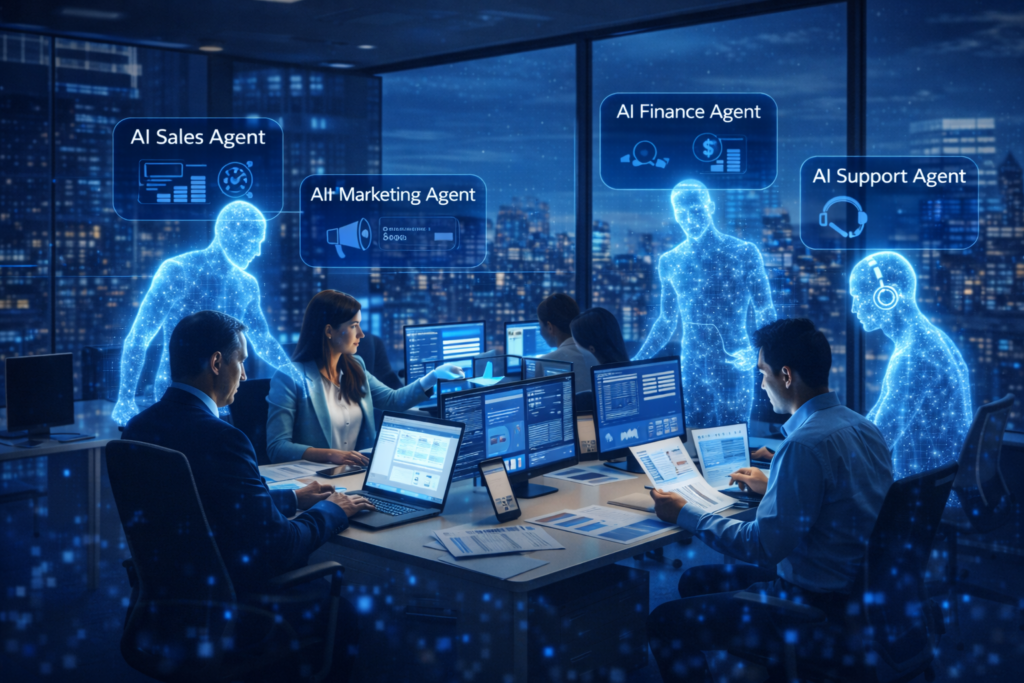
Imagine:
A Sales Agent that identifies high-intent leads, qualifies them, personalizes outreach, and negotiates pricing parameters. A Marketing Agent that dynamically reallocates ad budgets, generates campaign variants, and optimizes targeting in real time. A Finance Agent that monitors cash flow, forecasts revenue scenarios, and manages risk thresholds. An Operations Agent that predicts inventory requirements and adjusts supply chain strategies. A Support Agent that resolves complex tickets using contextual memory and historical interaction data.
Instead of static teams, businesses operate with a coordinated digital workforce.
Humans shift from task execution to system supervision and strategic refinement.
Multi-Agent Coordination as Infrastructure
A single AI agent cannot run a modern enterprise.
Scalable businesses require multi-agent coordination.
In this structure:
Each agent has defined boundaries. Responsibilities are modular. Communication protocols are standardized. Shared memory environments synchronize data.
There are several coordination models emerging:
1. Central Orchestrator Model
A supervisory agent assigns tasks and aggregates outcomes.
2. Shared Memory Model
Agents operate independently but access a unified knowledge layer.
3. Hierarchical Delegation
High-level agents define strategy; lower-level agents execute subtasks.
4. Event-Driven Architecture
Agents respond dynamically to real-time triggers.
Poor coordination creates redundancy, conflict, and inefficiency.
Strong coordination enables exponential scalability.
The companies that master coordination architecture will operate at a speed and precision traditional firms cannot match.
The Economics of Autonomous Operations
Autonomous businesses fundamentally change cost structures.
Traditional scaling requires:
Hiring Training Supervision Infrastructure expansion
Agent-based scaling requires:
Compute resources API integrations Governance systems Monitoring layers
This shift lowers marginal operational costs.
For example:
Increasing customer support volume no longer requires proportional hiring. Marketing experimentation scales algorithmically. Forecasting and reporting happen continuously.
The economic impact is significant:
Reduced fixed labor costs Increased operational elasticity Faster experimentation cycles Improved resource allocation efficiency
However, this does not eliminate humans.
It changes where human value is applied.
Creativity, ethics, brand direction, and high-level strategy remain human-driven — at least for the foreseeable future.
Governance: The Hidden Backbone
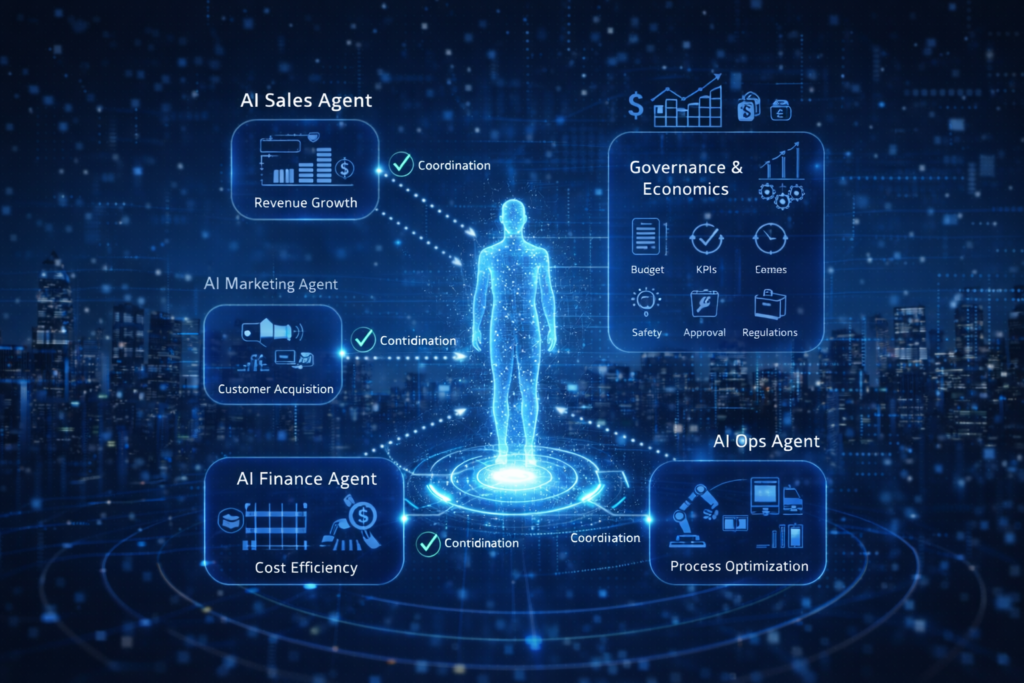
Autonomy without governance introduces systemic risk.
Autonomous businesses require embedded safety layers:
Permission boundaries Action thresholds Approval workflows Audit logging Human override capabilities
As agents gain authority to execute financial transactions, adjust pricing, communicate externally, and manage customer interactions, oversight becomes critical.
Governance systems must answer:
What actions can be fully autonomous? Which require human review? How are decisions logged? What are escalation triggers?
By 2030, regulatory frameworks may require transparent AI operational logs, especially in finance, healthcare, and infrastructure sectors.
Autonomy must operate within constraint architecture.
Cultural Transformation Inside Organizations
The shift to autonomous operations is not purely technical.
It is cultural.
Companies must transition from:
“Who is responsible for this task?”
to
“Which system layer governs this objective?”
Managers evolve into system architects.
Teams evolve into oversight units.
KPIs shift from task completion to system performance metrics.
Resistance will occur.
Employees may fear displacement. Leaders may resist loss of centralized control.
However, history shows that organizations that resist structural transformation fall behind those that redesign themselves.
Autonomous businesses are not replacing human companies.
They are redefining how human-led companies operate.
Competitive Advantage in the Autonomous Era
By 2030, competitive gaps will widen dramatically between:
Reactive companies Semi-automated companies Fully agent-structured companies
Fully autonomous-structured organizations will:
Respond to market changes instantly Continuously optimize margins Detect inefficiencies early Scale internationally with minimal overhead Operate 24/7 without productivity degradation
The advantage will not simply be speed.
It will be structural intelligence.
Businesses designed around coordinated AI agents will outperform those relying on manual orchestration.
Risk and Strategic Caution
Despite the promise, autonomy carries risk.
Over-reliance on poorly tested systems can result in:
Brand damage Financial miscalculations Regulatory violations Security vulnerabilities
Companies must avoid premature over-automation.
Autonomous transformation should follow phased implementation:
Assistive AI Semi-autonomous systems Bounded autonomy Coordinated multi-agent ecosystems
Strategic patience is essential.
The Role of Humans in 2030
The question is not whether AI replaces humans.
The question is: where do humans operate within autonomous businesses?
Future roles may include:
AI Systems Architect Agent Governance Officer Autonomous Operations Strategist Ethical Oversight Manager AI Infrastructure Analyst
Humans will increasingly supervise intelligent systems rather than execute repetitive workflows.
The nature of work changes — not necessarily the existence of work.
The Evolution Toward Self-Optimizing Enterprises
The most advanced autonomous businesses will eventually:
Refine goals based on performance trends Detect new revenue opportunities independently Reallocate capital dynamically Simulate market scenarios continuously Operate with predictive decision layers
These are not science fiction projections.
The building blocks already exist.
What is missing is widespread structural redesign.
The companies that embrace agent-based infrastructure early will define the next era of digital enterprise.
Conclusion
The future of autonomous businesses is not about installing AI tools.
It is about redesigning the operational skeleton of companies.
By 2030:
Departments will evolve into specialized AI agents. Coordination will occur algorithmically. Decision-making will be distributed. Governance will be embedded at the architectural level.
The winners of the next decade will not simply use AI.
They will structure their companies around it.
Autonomy is not an upgrade.
It is a new operating system for business.
Frequently Asked Questions (FAQ)
What is an autonomous business?
An autonomous business operates through coordinated AI agents that handle core operational functions such as sales, marketing, finance, and support with minimal human intervention.
Will AI agents replace entire departments?
AI agents will replace repetitive operational tasks within departments. Strategic direction, ethical oversight, and high-level decision-making will likely remain human-led.
Are autonomous businesses realistic by 2030?
Yes. The technology components already exist. The primary barrier is organizational redesign and governance adaptation.
What industries will adopt autonomy first?
E-commerce, fintech, SaaS, digital marketing, and logistics are likely early adopters due to their data-rich environments.
What is the biggest challenge in building an autonomous business?
The biggest challenges include governance design, system coordination complexity, cultural resistance, and ensuring reliable data infrastructure.