
Introduction
AI agents are often discussed as intelligent assistants or automation tools. However, their true power lies in architecture.
An AI agent is not just a language model responding to prompts. It is a structured system composed of memory layers, reasoning engines, tool integrations, and feedback mechanisms.
Understanding this architecture is essential for anyone building or deploying agent-based systems.
What Is AI Agent Architecture?
AI agent architecture refers to the structural design that enables an agent to:
Understand goals Process context Make decisions Take actions Learn from outcomes
Without architecture, an AI model is reactive.
With architecture, it becomes operational.
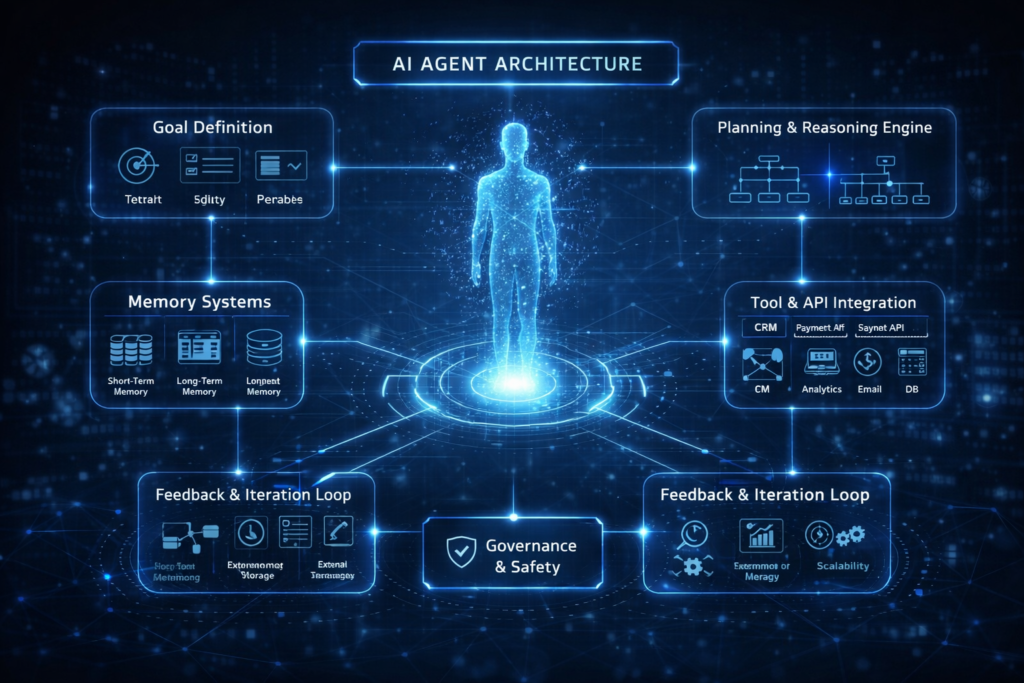
Core Components of an AI Agent
1. Goal Definition Layer
Every agent begins with a defined objective.
Examples:
Increase conversion rate Reduce customer support resolution time Optimize ad spend allocation
The clearer the goal, the more measurable the output. This layer defines boundaries and constraints.
2. Memory Systems
Memory transforms a model from reactive to contextual.
There are typically three memory layers:
Short-Term Memory
Stores recent interactions within a session.
Long-Term Memory
Stores structured historical data and patterns.
External Memory Storage
Databases, vector stores, or knowledge bases integrated via APIs.
Memory enables continuity and improved decision-making.
3. Planning and Reasoning Engine
This layer is responsible for:
Breaking large goals into sub-tasks Evaluating possible actions Selecting optimal execution paths
Modern agent systems use structured reasoning frameworks and task decomposition strategies.
Planning separates simple chatbots from operational agents.
4. Tool and API Integration
An AI agent becomes powerful when it interacts with external systems.
Examples:
CRM systems Payment processors Analytics dashboards Email platforms Databases
Tool integration allows agents to act, not just respond.
5. Feedback and Iteration Loop
An agent must evaluate results.
This layer enables:
Performance tracking Error detection Strategy refinement
Without feedback loops, agents cannot improve. Autonomy depends on iteration.
From Single-Agent to Multi-Agent Systems
Most early implementations focus on a single agent.
However, scalable businesses require specialization.
A multi-agent system distributes responsibilities:
Sales Agent Marketing Agent Finance Agent Operations Agent Support Agent
Each agent operates within defined parameters but coordinates toward shared objectives. This creates a digital workforce structure.
Agent Coordination Mechanisms
In multi-agent systems, coordination is critical.
Common approaches include:
Central controller agent Shared memory environment Hierarchical task delegation Event-driven communication
Poor coordination results in redundancy or conflict. Strong coordination increases efficiency and scalability.
Governance and Safety Layers
Advanced agent systems require oversight.
Critical governance components include:
Permission controls Action approval thresholds Audit logging Performance boundaries Human override systems
Architecture without governance introduces risk. Autonomy must operate within constraints.
Scalability Considerations
As systems grow, complexity increases.
Key scalability factors:
Modular design Clear agent boundaries API standardization Data consistency management Latency optimization
Well-designed architecture scales horizontally, not just vertically.
The Future of Agent Infrastructure
Agent architecture is evolving toward:
Distributed multi-agent ecosystems Persistent memory layers Self-evaluating performance metrics Autonomous goal refinement
Businesses adopting structured agent architecture will gain operational leverage over reactive competitors.
Architecture is not optional. It is foundational.
Conclusion
AI agents are not simply prompt-based tools. They are structured operational systems.
True autonomy requires:
Clear goals Layered memory Reasoning frameworks Tool integration Continuous feedback Governance controls
Understanding architecture is the first step toward building scalable, reliable agent-based infrastructure.
The companies that master this structure will define the next generation of digital operations.
Frequently Asked Questions (FAQ)
What is the difference between an AI model and an AI agent?
An AI model generates responses based on input. An AI agent uses a structured architecture that includes goals, memory, reasoning, and tool integration to execute tasks autonomously.
Why is memory important in AI agent architecture?
Memory enables context retention and long-term learning. Without memory, an agent cannot adapt based on past actions or improve its decision-making accuracy.
Can a single AI agent run an entire business?
In most cases, no. Scalable systems rely on multi-agent coordination where specialized agents handle different operational areas.
What is the biggest risk in AI agent deployment?
The biggest risks include poor governance, over-automation, weak permission controls, and lack of human oversight. Architecture without safety layers can create operational instability.
Do AI agents require coding skills to implement?
Advanced architecture requires technical knowledge. However, low-code and orchestration platforms are increasingly making agent deployment accessible to non-developers.
What is a multi-agent system?
A multi-agent system is a network of specialized AI agents that coordinate through shared objectives or communication protocols to manage complex workflows.